

Oil Price Surge During the 2026 US-Iran War
Impact on Thailand and Southeast Asia — A Practical Guide for Businesses
MSC Law and Business Review • Q1/2026
By Sawita Suwansawat
Who this article is for
Thai and Southeast Asian businesses — importers, manufacturers, traders, developers, and their legal advisers — whose contracts, supply chains, or financing arrangements have been disrupted by the surge in oil prices following the outbreak of the US-Iran War in February 2026.
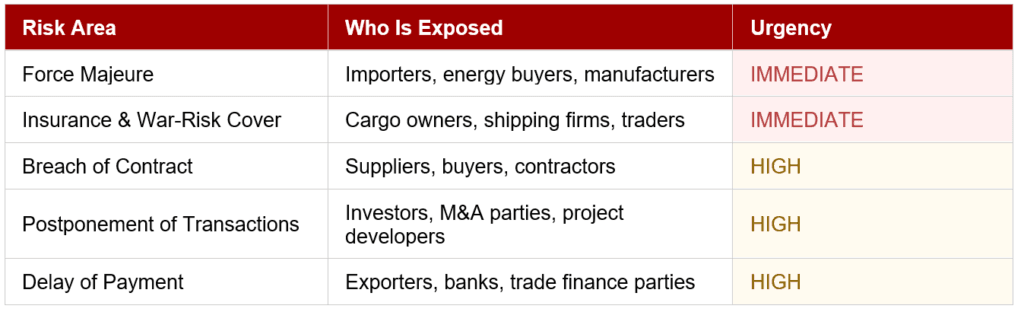
Quick Reference: The Five Key Risks
Each risk is explained in full in the sections below. Use this table to identify which sections are most relevant to your situation.
The Situation in Thailand and Southeast Asia
On February 28, 2026, US and Israeli forces struck Iran. Iran responded by closing the Strait of Hormuz — the waterway through which roughly 80% of Asia’s oil imports normally pass. The effects were immediate and severe across Southeast Asia, but no country in the region is more exposed than Thailand.
Thailand generates more than half of its electricity from LNG, around 40% of which comes from the Middle East. Thailand and the Philippines import between 60% and 95% of their crude oil supply. Vietnam depends on Middle Eastern sources for nearly 90% of its oil imports. The region entered the crisis with limited buffers: Thailand held approximately 65 days of reserves, the Philippines around 50 to 60 days, and Vietnam less than 20 days.
The Thai government has declared an energy emergency, suspended petroleum exports (except to Cambodia and Laos), capped diesel prices, and directed state agencies to work from home. The baht has come under downward pressure. KKP Research has warned that GDP growth could fall to as low as 0.7% if the conflict is prolonged. Tourism — already softening — saw a 9% year-on-year drop in arrivals in the first week of March, with hotel occupancy at major sites falling as low as 10%.
Petrochemical companies including Singapore’s Aster Chemicals and Energy have declared force majeure. The legal cascade has begun. Here is what that means for businesses across the region.
1. Force Majeure — When Your Supplier Says It Cannot Deliver
What is force majeure?
Force majeure is a clause in a contract that allows a party to suspend or cancel its obligations without penalty when an extraordinary event — such as war, natural disaster, or government order — makes performance impossible. Most energy supply contracts, LNG sale-and-purchase agreements, commodity trading contracts, and logistics agreements include one.
Gulf producers including QatarEnergy, Kuwait Petroleum, and Bahrain’s BAPCO have formally declared force majeure on oil and gas exports. Singapore’s Aster Chemicals and China’s Wanhua Chemical have done the same on petrochemical supplies into the region. If your business relies on any of these supply chains, you have likely already received — or will soon receive — a force majeure notification.
What is force majeure?
Force majeure declarations are not automatically valid. Under both Thai civil law (Section 8 of the Thai Civil and Commercial Code) and the governing law of most international supply contracts (typically English law or Singapore law), the declaring party must show:
- The event was unforeseeable and beyond their reasonable control.
- The event actually prevented performance — not merely made it more expensive or inconvenient.
- They took reasonable steps to mitigate the impact before invoking the clause.
They gave timely written notice in accordance with the contract’s requirements (usually 5 to 14 days from the onset of the event).
Important distinction under Thai law
Under Section 8 of the Thai Civil and Commercial Code, force majeure requires that performance be truly impossible — not just commercially impractical. Thai courts, like Singapore courts, interpret these clauses narrowly. A supplier whose facility was undamaged but whose logistics costs increased sharply is unlikely to succeed with a force majeure claim. Whether the current Strait of Hormuz closure meets the threshold will depend on the specific contract language and the facts of each case.
Your risk as the buyer or importer
Even if a force majeure notice you receive is valid, it does not automatically protect you from your own customers downstream. If your sale contracts with your own buyers have tighter force majeure clauses — or none at all — you may find yourself simultaneously excused from receiving supply but still legally obligated to deliver. This pass-through gap is one of the most common and costly contract risks in the current environment.
For Thai businesses buying LNG, crude, or petrochemicals under long-term agreements: the force majeure clause typically suspends delivery obligations but does not cancel the contract. Pricing mechanisms remain in force. You cannot simply terminate and rebook at spot market rates without contractual authority to do so.
What to do now
- Review every active supply agreement. Identify the force majeure clause, the governing law, and the notice requirements. Do this immediately — notice deadlines are short.
- If you receive a force majeure notice, respond in writing promptly. Acknowledge receipt without conceding the notice is valid. Expressly reserve your right to challenge it.
- If you are considering invoking force majeure yourself, seek legal advice first. Wrongly invoking it is itself a breach of contract and can expose you to damages.
- Document your mitigation efforts. Keep records of attempts to source alternative supply, reroute shipments, or adjust operations. This is essential to any future dispute or claim.
2. Insurance and Claims Exposure — The Cover That Disappeared
What happened to war-risk insurance?
Within 72 hours of the conflict beginning, marine insurers began issuing cancellation notices withdrawing war-risk cover for vessels transiting the Persian Gulf and the Strait of Hormuz. War-risk premiums for Gulf routes increased by up to twelve times their pre-war level overnight. Some policies were cancelled outright. For Southeast Asian importers — whose goods travel through the Strait — this created an immediate and serious coverage gap.
More than a dozen commercial vessels have been struck in or near the Strait since the war began. Maersk and other carriers rerouted ships via the Cape of Good Hope, adding 10 to 14 sailing days and approximately USD 1 million in additional fuel costs per voyage. The cost — and legal responsibility — of those extra expenses depends entirely on what your shipping and cargo contracts say.
The three problems for Thai and SEA businesses
First: uninsured cargo. Goods already at sea, or in transit arrangements confirmed before cover was withdrawn, may be travelling without valid war-risk insurance. If a vessel is attacked, detained, or destroyed, cargo owners without cover face total uninsured loss. Thai importers should urgently verify the current insurance status of all in-transit shipments.
Second: policy exclusions. Even where a policy remains technically in force, most marine insurance contracts contain exclusions for acts of war, sanctions-linked incidents, and government seizure. The interaction of these exclusions with the current conflict is complex and fact-specific. Do not assume your policy covers you without checking.
Third: rerouting cost disputes. When a carrier reroutes your cargo via the Cape of Good Hope, who pays the extra freight? This depends on whether your contract is a spot booking, a long-term freight agreement, or governed by a standard bill of lading. Many contracts contain war-risk surcharge provisions, but their exact scope is often disputed. Thai importers who accepted standard carrier terms without negotiation are most at risk.
What to do now
- Contact your cargo insurer and broker immediately. Confirm in writing whether your current policy covers cargo in transit through or near the Strait of Hormuz. Ask for confirmation of any war-risk exclusions or cancellation notices that apply to your policy.
- For goods not yet shipped: do not dispatch without confirming war-risk cover is in place or that the cargo is travelling via a covered route (e.g., Cape of Good Hope).
- Review your freight contracts and bills of lading. Identify who bears the cost of rerouting and war-risk surcharges. If this is unclear, take legal advice before accepting invoices for additional costs.
Consider whether political risk or trade credit insurance can fill the gap where marine cover has been withdrawn. Specialist insurers and export credit agencies (including EXIM Thailand) may be able to provide partial coverage.
3. Breach of Contract — When a Party Simply Cannot or Will Not Perform
The difference between force majeure and breach
Not every failure to deliver is a force majeure event. Where a supplier stops delivering because costs have risen and the contract has become unprofitable — rather than because performance is truly impossible — force majeure does not apply. That is a breach of contract. In the current environment, both categories are occurring simultaneously, and the distinction matters enormously for the remedies available to you.
Under Thai law and under most governing laws applied to regional commercial contracts (English law, Singapore law), a party in breach is liable for damages caused by that breach. The innocent party also has an obligation to mitigate its losses — meaning it must take reasonable steps to obtain alternative supply rather than simply sitting on the loss.
Where breach risk is highest in Thailand and Southeast Asia
The most acute breach risks in the current environment are concentrated in the following types of contracts:
- Energy and fuel supply agreements. Sellers locked into fixed-price domestic supply contracts — such as LNG supply agreements with Thai industrial users or power generators — face severe margin pressure as their acquisition costs surge while their contracted sale prices remain fixed. Some will breach. Buyers under these contracts should review their rights to claim damages or terminate.
- Construction and infrastructure contracts. Projects across the region depend on diesel and fuel oil for equipment operation. Where contracts did not provide for fuel cost escalation, contractors face losses they cannot absorb. Project owners should expect contractors to raise change-of-law or cost escalation arguments, some of which have legal merit.
- Manufacturing and export contracts. Thai manufacturers — particularly in automotive, electronics, and food processing — face rising energy input costs. Where they supply goods at fixed contract prices to international buyers, they bear the cost increase. Where they cannot absorb it, disputes over price, delivery timing, and specification will follow.
- Tourism and hospitality sector contracts. Hotels, tour operators, and airlines in Thailand face both a demand collapse (tourist arrivals down 9% in early March) and rising operating costs. Group booking and venue contracts with fixed cancellation terms are likely to generate disputes as operators and clients argue over who bears the loss of cancellation.
Remedies under Thai law
Thai courts apply the Civil and Commercial Code to breach of contract claims. Key remedies include:
- Damages: The innocent party may claim actual losses caused by the breach, including cost of cover (replacement supply at higher prices). However, damages must be foreseeable and the claimant must have mitigated.
- Liquidated damages: Many contracts include pre-agreed penalty clauses (“liquidated damages”) for late delivery or non-performance. Thai courts will generally enforce these unless they are deemed a penalty rather than a genuine pre-estimate of loss.
- Termination: Where breach is material, the innocent party may terminate the contract and pursue damages. Clear contractual termination provisions are important — do not purport to terminate without legal advice, as a wrongful termination is itself a breach.
Arbitration: Most international commercial contracts in Thailand include SIAC, ICC, or THAC arbitration clauses. Dispute resolution is more likely to occur via arbitration than litigation.
What to do now
- Identify contracts where your counterparty is likely to be under financial stress. Engage proactively rather than waiting for a formal default. In many cases, a renegotiated price or delivery schedule is preferable to litigation.
- Preserve evidence of all communications and all losses. If you intend to claim damages, you will need to demonstrate the breach, causation, and the quantum of loss.
- Check your own exposure. If your own performance obligations are at risk, assess whether force majeure, hardship, or cost escalation provisions give you any contractual relief before you are in breach.
4. Postponement of Transactions — Deals That Cannot Close
Why transactions are stalling
The oil price shock and associated economic uncertainty have created severe disruption for business transactions that were in progress when the conflict began. M&A deals, project finance closings, joint ventures, property transactions, and trade finance arrangements are all affected. The common thread is uncertainty: when oil prices are volatile, asset valuations shift, lending conditions tighten, and parties become reluctant to commit.
In Thailand specifically, the economic outlook has deteriorated sharply. KKP Research has revised its GDP growth forecast down to as low as 0.7% in a prolonged conflict scenario. The baht faces downward pressure from a deteriorating current account (Thailand’s net energy imports account for roughly 6.5% of GDP). Foreign investors in ongoing deals are reassessing risk and seeking price adjustments or extended due diligence periods.
The specific legal issues arising from postponement
Where a transaction is governed by a sale and purchase agreement, heads of terms, or a commitment letter, the parties’ rights to delay or withdraw depend on the specific contract language. Common issues include:
- Material Adverse Change (MAC) clauses. Most M&A sale and purchase agreements include MAC clauses allowing a buyer to walk away if there has been a material adverse change in the target’s business between signing and closing. A business heavily exposed to energy costs — such as a Thai logistics company, manufacturer, or hotel chain — may have experienced exactly this. Buyers considering invoking MAC clauses should take advice on whether the economic disruption constitutes a MAC under their specific contract’s definition.
- Conditions precedent and long-stop dates. Where a transaction closing is conditional on financing, regulatory approval, or third-party consent, long-stop dates may lapse before conditions can be satisfied. Parties should review whether MAC provisions, force majeure, or material disruption language in their transaction documents gives them the right to extend or terminate without liability.
- Project finance and lending commitments. Banks and lenders with outstanding term sheet commitments to energy-intensive or logistics-sector borrowers in Thailand and Southeast Asia are reviewing their exposure. Borrowers should check whether their commitment letters include market disruption provisions or material adverse change language that could permit lenders to withdraw.
- Real estate and property transactions. Commercial property transactions — particularly those involving hotels, industrial estates, and logistics facilities — are facing valuation disputes and buyer cooling-off demands. Thai property contracts often contain specific conditions precedent relating to zoning, financing, and environmental compliance; delays in satisfying these conditions are becoming more common.
Practical note for Thai M&A and real estate transactions
Thai law does not have a general statutory MAC doctrine equivalent to those in English or US law. Whether a MAC has occurred, and what rights it confers, is entirely a function of the contractual language. Many Thai domestic contracts are drafted without robust MAC provisions. If your deal documentation is silent on what happens in an event of economic disruption of this scale, the default position under Thai law may not be what you expect. Seek advice from Thai-law counsel before asserting or resisting a MAC claim.
What to do now
- Review all pending transactions and their closing conditions. Identify any MAC clauses, material disruption provisions, force majeure language, and long-stop dates.
- Open a dialogue with your counterparty. Where both parties have an interest in completing the transaction, negotiated extensions and price adjustments are usually preferable to disputed terminations.
- For lenders and investors: document your assessment of whether a MAC has occurred, and seek legal advice before communicating to the other party. MAC assertions that are later found to be wrong can themselves constitute breach.
- Preserve all correspondence and valuations. These will be critical evidence if the postponement becomes a formal dispute.
5. Delay of Payment — When Cash Stops Moving
Why payments are being delayed
Payment delays are emerging across multiple channels in the region. The causes are overlapping: some counterparties cannot pay because their businesses have been disrupted; some banks are delaying processing of payments connected to sanctioned parties or flagged jurisdictions; and some buyers are deliberately withholding payment in the hope of renegotiating contract terms. All three require different legal responses.
For Thailand specifically: the depreciation pressure on the Thai baht adds a further layer of risk for businesses receiving payments in local currency but holding obligations in US dollars or euros. A payment made on time in baht may still represent a real-terms shortfall if the currency has moved significantly.
Trade finance and letter of credit risks
Letters of credit (LCs) and documentary collections are the primary payment instruments in Thai and Southeast Asian commodity trade. The current conflict creates specific risks in the LC context:
- Presentation delays: Where shipping documents are delayed — because vessels have been rerouted, bills of lading reissued for Cape of Good Hope routing, or port of discharge changed — the documents presented under an LC may not match the credit terms. Banks are entitled to refuse non-conforming presentations.
- Confirming bank withdrawal: Some confirming banks have declined to add confirmation to new LCs where the issuing bank is in a high-risk jurisdiction, or where the LC relates to a cargo transiting a war-risk zone. This leaves the exporter without the payment guarantee they expected.
- Force majeure on payment: Some buyers have attempted to invoke force majeure to justify withholding payment. This is almost always wrong: payment obligations under an LC are autonomous of the underlying commercial contract and cannot be suspended by force majeure arguments relating to the supply disruption.
Currency and foreign exchange issues
Where contracts are denominated in USD but performance and payment are occurring in Thailand, the depreciation of the baht creates a financial gap between what was contractually expected and what is economically received. Businesses should review:
- Whether their contracts contain currency protection provisions or indexation to USD or EUR.
- Whether their hedging arrangements remain adequate given the speed and scale of currency movement.
- Whether force majeure or material adverse change language in their contracts is broad enough to address currency disruption — in most standard commercial contracts, it is not.
Debt service and banking covenants
Thai businesses with USD-denominated debt — common in the property, hospitality, and energy sectors — face increased debt service costs in baht terms. Where loan agreements contain financial covenants (such as debt-service coverage ratios or minimum EBITDA requirements), the combined impact of lower revenues and higher costs may trigger a covenant breach. Businesses should review their loan covenants urgently and, if breach is likely, open early discussions with their lenders rather than waiting for a formal default notice.
What to do now
- Audit your receivables immediately. Identify which counterparties are in financial stress and prioritise collection efforts accordingly.
- Review all outstanding letters of credit. Check that shipping document presentations will conform to credit terms notwithstanding any rerouting or delivery changes. If documents will not conform, contact the issuing bank proactively.
- For delayed payments: send a formal written demand for payment as soon as a payment deadline is missed. Under Thai law, interest on late commercial payments accrues at the rate specified in the contract, or at the statutory rate of 7.5% per annum if no contractual rate is specified.
- Review loan covenants. If any financial covenants are at risk of breach, approach your lender now. A proactive waiver request is almost always more favourable than a lender-initiated event of default.
Overall Checklist: Ten Things to Do This Week
Regardless of which of the five risks above is most immediately relevant to your business, every business in Thailand and Southeast Asia with significant commercial contracts, supply arrangements, or financing should complete the following steps as a priority:
- Audit all active contracts for force majeure clauses, MAC provisions, and long-stop dates.
- Check your cargo and marine insurance: confirm war-risk cover status for all in-transit and pending shipments.
- Respond in writing to any force majeure notices received: acknowledge receipt, reserve your rights, do not accept validity without advice.
- Review your own obligations: identify any contracts where you are at risk of being in breach and assess whether you have contractual protection.
- Check pending transactions: identify MAC clauses, long-stop dates, and conditions precedent that may be affected by the current environment.
- Audit your receivables: identify counterparties at financial stress and escalate collection where appropriate.
- Review all LC presentations: verify that documents conform to credit terms notwithstanding any delivery changes.
- Review loan covenants: check whether financial covenants are at risk of breach and approach lenders proactively.
- Review currency exposure: assess whether your contracts, hedging, and receivables adequately protect you against baht depreciation.
- Document everything: preserve records of all communications, disruptions, losses, and mitigation steps. This documentation will be essential in any future dispute or claim.
DISCLAIMER
This article is prepared for general informational and educational purposes only. It does not constitute legal advice and does not create a lawyer-client relationship. Analysis is based on information available as of March 31, 2026. The situation described is subject to rapid change. Businesses should seek qualified legal counsel in the relevant jurisdiction before taking any action. The author and publisher disclaim all liability for actions taken or not taken in reliance on this article.